Heated drying rack vs dehumidifier
One adds heat to your clothes. The other takes water out of your air. Only one of them fixes the damp room as well.
We have not tested these products and we do not pretend to have. Here is what we did instead. Links to Amazon earn us a commission at no extra cost to you - disclosure.
| # | Rack | Best for | Open footprint | Price |
|---|---|---|---|---|
| 1 | 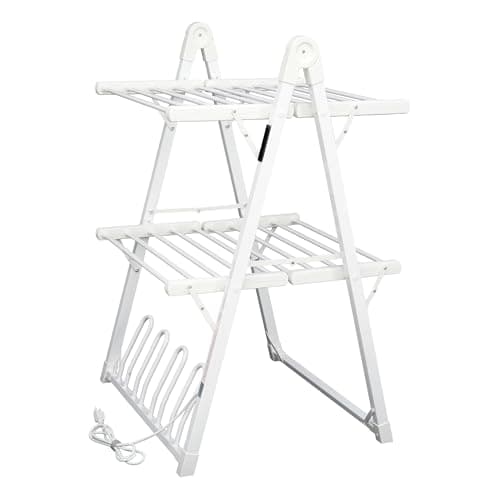 SHARNDY Heated Clothes Drying Rack, Foldable with Timer (White)Top pickThe only compact heated rack here that publishes a wattage. At a rated 270 W you can work out the bill before you buy it, which is not true of most of this category. | Knowing what it costs | 23"D x 39"W x 25"H | |
| 2 | 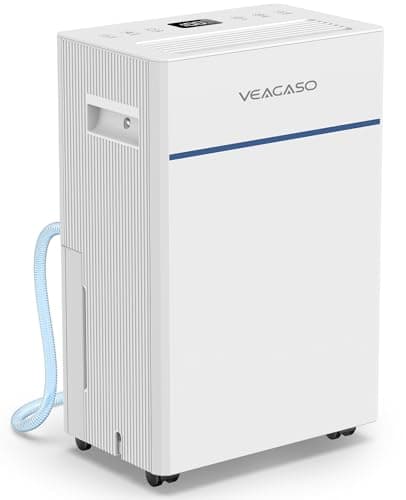 VEAGASO Dehumidifier, 28 Pints, 2000 Sq Ft28 pints a day on a published 158 W draw - the best pints-per-watt figure here, and quiet enough at 38 dB to run in a bedroom. | Drying a load overnight | 10.6"D x 6.7"W x 15.9"H | |
| 3 | 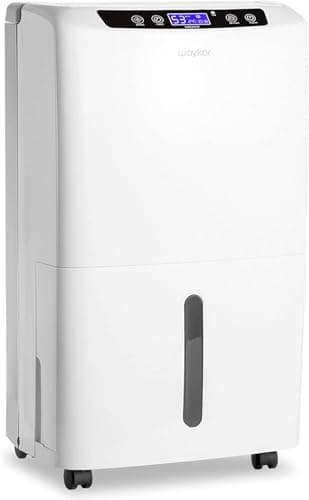 Waykar 34 Pint Energy Star Dehumidifier, 2000 Sq Ft34 pints a day across 2,000 square feet with a 90 degree aimable vent, from the one unit here sized for a flat rather than a room - and it publishes no wattage. | A whole damp apartment | 12.08"D x 8.46"W x 19.84"H |
These get compared because they cost about the same and both promise faster indoor drying. They work in opposite directions, and that difference decides which one belongs in a small apartment.
The mechanisms are not the same
A heated rack warms the garment. Warmer water evaporates faster, so the clothes give up moisture more readily - into the room. A dehumidifier does not touch the clothes at all; it lowers the humidity of the room air, and dry air pulls moisture out of wet fabric far faster than saturated air does. One pushes water out of the fabric; the other pulls it, and then keeps it.
The decision table
| 270 W heated rack | 158 W dehumidifier | |
|---|---|---|
| Running cost per session | 25¢ over 5 h | 23¢ over 8 h |
| What it heats | The garments | Nothing much |
| Effect on room humidity | Raises it | Lowers it |
| Works in a closed room | Yes, but the air saturates | Yes - that is the ideal case |
| Helps with damp walls and mold | No | Yes |
| Useful when not doing laundry | No | Yes |
| Noise | Silent | 38-45 dB |
| Needs emptying | No | Yes, or a drain hose |
The deciding factor: what happens to the water
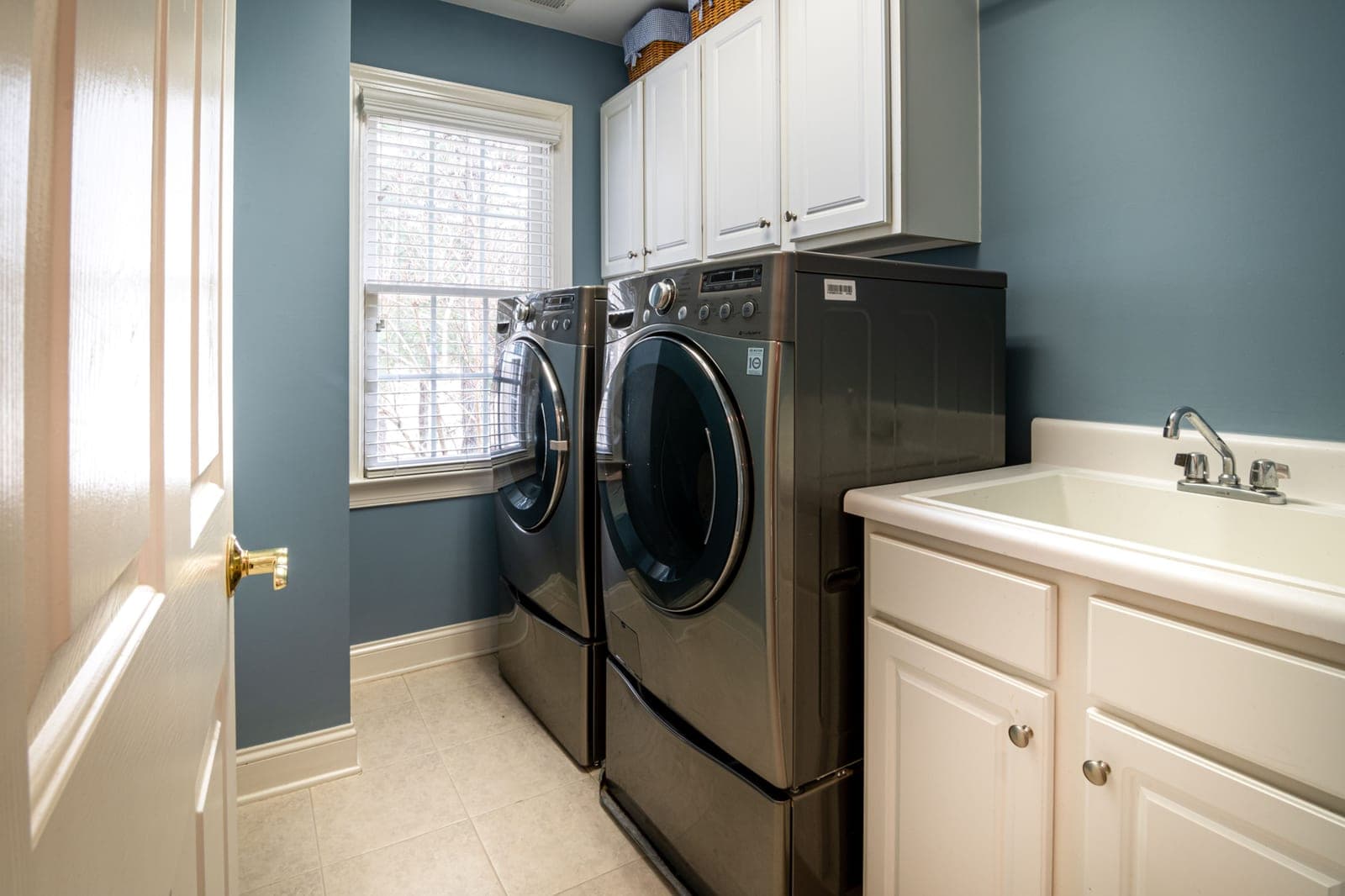
A washer load holds roughly two to five pints of water. Air-drying it indoors moves all of that into your apartment's air. In a house it disperses; in a studio in winter with the windows shut it condenses on the coldest surface in the room, which is usually a window or an exterior wall.
A heated rack accelerates that process. A dehumidifier reverses it - the same pints end up in a tank you pour down the sink. In a small home this is not a marginal difference; it is the difference between drying laundry and slowly making a damp room.
When the heated rack is the right answer
- A cold room with good ventilation. If a window is open or the room has an extractor, the humidity takes care of itself and the heat is what is missing.
- You need warm dry towels rather than fast drying. A dehumidifier cannot do that.
- Space is desperately tight. A folding heated rack is a rack you already needed; a dehumidifier is an extra object.
- Silence matters. A heated rack makes no noise; a compressor dehumidifier makes 38 to 45 dB.
When the dehumidifier is the right answer
- A small closed room in winter. This is the common case, and it is the one the dehumidifier is built for.
- Windows fog or walls feel damp. That is a humidity problem, not a drying problem.
- You want the device to earn its keep year round. A dehumidifier runs in a damp bedroom in August; a heated rack does not.
- You are already using a rack you like. Add the dehumidifier and keep the rack.
The products
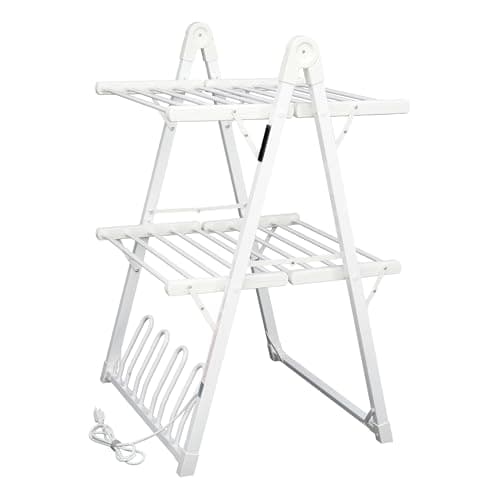
Top pick · Knowing what it costs
SHARNDY Heated Clothes Drying Rack, Foldable with Timer (White)
The only compact heated rack here that publishes a wattage. At a rated 270 W you can work out the bill before you buy it, which is not true of most of this category.
What the manufacturer publishes
- Open
- 23"D x 39"W x 25"H
- Folded
- Collapses to approximately 41.34" x 25.98" x 2"
- Drying line
- 2 tiers plus a shoe rack (linear feet not published)
- Load capacity
- Not published
- Material
- Aluminum
- Rated wattage
- 270 W
Costs 5¢ an hour to run - 24.8¢ for a 5-hour session, at 18.34¢/kWh (US residential average, June 2026).
Figures from Manufacturer listing on Amazon, retrieved 2026-09-02.
270 W is a published, checkable number, and it is the reason this is the top pick. Everything else in the compact class publishes a temperature range instead, which cannot be turned into money.
At the current US average rate a 270 W rack costs about 5 cents an hour to run. Five hours is roughly 25 cents - less than a fifth of what the same load costs in a tumble dryer.
The 2 inch folded thickness is the other reason it suits an apartment: it goes behind a door, which a rigid heated tower does not.
SHARNDY publishes no load capacity. The frame is aluminum and light; treat it as a shirts-and-underwear rack rather than a bedding rack.
Good
- Publishes a rated wattage - most of this category does not
- Folds to about 2 inches thick
- Built-in timer and three-stage overheat protection
- Dedicated shoe section
Not so good
- No published load capacity
- No published drying-line length
Skip this if you need to dry a full load at once. This is a 39 inch wide rack, not a substitute for a dryer.
#ad · how this is funded · price as of October 16, 2026
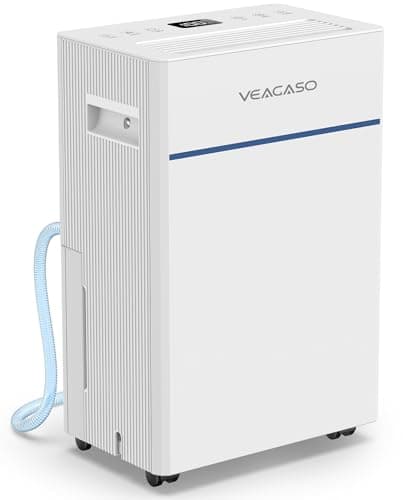
Pick 2 · Drying a load overnight
VEAGASO Dehumidifier, 28 Pints, 2000 Sq Ft
28 pints a day on a published 158 W draw - the best pints-per-watt figure here, and quiet enough at 38 dB to run in a bedroom.
What the manufacturer publishes
- Open
- 10.6"D x 6.7"W x 15.9"H
- Folded
- Not applicable
- Drying line
- Not applicable
- Load capacity
- 28 pints per day
- Material
- Compressor dehumidifier
- Rated wattage
- 158 W
Costs 2.9¢ an hour to run - 14.5¢ for a 5-hour session, at 18.34¢/kWh (US residential average, June 2026).
Figures from Manufacturer listing on Amazon, retrieved 2026-09-02.
A dehumidifier does not blow air at your laundry; it removes the water your laundry has just put into the room. That is why it dries a closed room full of washing and a fan does not.
158 W is the number to compare against a heated rack. Running it for eight hours costs about 23 cents at the current US average rate - roughly what a 270 W heated rack costs for five.
38 dB is quiet enough to sleep through, which matters because the natural way to use one is overnight in a closed room with the rack.
This is a compressor unit, not a thermoelectric one, which is why it can pull 28 pints where the small desktop units manage a fraction of that.
Good
- 158 W published - the running cost is calculable
- 28 pints per day
- 38 dB quiet mode
- 16.5 lb, portable between rooms
Not so good
- 35.3 cfm airflow is modest, so it works best in a closed room
- Compressor units lose capacity in a cold room
- Tank needs emptying or a hose run
Skip this if your drying room is under about 60 F. Compressor dehumidifiers slow down badly in the cold - that is a physics limit, not a brand problem.
#ad · how this is funded · price as of October 16, 2026
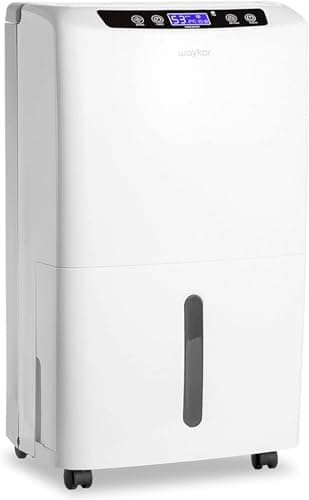
Pick 3 · A whole damp apartment
Waykar 34 Pint Energy Star Dehumidifier, 2000 Sq Ft
34 pints a day across 2,000 square feet with a 90 degree aimable vent, from the one unit here sized for a flat rather than a room - and it publishes no wattage.
What the manufacturer publishes
- Open
- 12.08"D x 8.46"W x 19.84"H
- Folded
- Not applicable
- Drying line
- Not applicable
- Load capacity
- 34 pints per day (at 95 F, 90% RH)
- Material
- Compressor dehumidifier, Energy Star certified
- Rated wattage
- not published
No wattage published. Waykar publishes a 34 pint rating, an Energy Star listing and a 2,000 sq ft coverage figure, but no rated wattage anywhere on the current listing. No running cost can be computed from a pint rating, so none is published here.
Figures from Manufacturer listing on Amazon, retrieved 2026-10-03.
The 34 pint rating is quoted at 95 F and 90% relative humidity, which is the industry test condition and not your apartment. Every dehumidifier's headline pint figure is quoted this way; expect less in a real room. Waykar at least states the conditions.
The 90 degree manual airflow swing is the feature worth having for laundry specifically - it lets you aim the dry outlet air at the rack, which turns the unit into a dehumidifier and a directional fan at once.
No rated wattage is published, so this site publishes no running cost for it. That is a real step down from the VEAGASO, which states 158 W and is therefore the only dehumidifier here whose cost per session can be calculated at all.
Humidity control runs 30% to 80% in 5% steps with a 3% hysteresis band, there is auto-defrost and a 24 hour timer, and it takes either the 0.66 gallon tank or a continuous hose. At 34 pints a day the tank is about four empties, so plan on the hose.
Good
- 34 pints a day with the test conditions stated
- Adjustable 90 degree airflow direction, aimable at a rack
- Energy Star certified, rated for 2,000 sq ft
- Dual drainage - 0.66 gallon tank or continuous hose
Not so good
- No published wattage, so no running cost can be computed
- No published airflow figure in cfm
- Headline pint rating is a test-condition figure, not a room figure
- Warranty is one year, extended to two only on registration
Skip this if you want to know what it costs to run. The VEAGASO publishes 158 W and this publishes nothing, which on a unit that runs for eight hours at a time is the specification that matters most.
#ad · how this is funded · price as of October 16, 2026
Common questions
Is a dehumidifier or a heated airer better for drying clothes?
A dehumidifier, in most small apartments. Both cost about the same to run, but the dehumidifier removes the water from your room instead of adding it, so it dries the laundry and fixes the damp at the same time.
Does a dehumidifier dry clothes faster than a heated rack?
In a closed room, usually yes. Evaporation stops when the surrounding air is saturated, and a dehumidifier keeps the air unsaturated. A heated rack in a closed room eventually saturates the air and slows down.
Can you use a dehumidifier and a heated drying rack together?
Yes, and in a cold damp apartment it is the best combination. Running both costs roughly 48 cents a session, still less than a standard tumble dryer load.
How much does a dehumidifier cost to run for drying clothes?
A 158 W unit for eight hours is about 23 cents at the June 2026 US residential average of 18.34 cents per kilowatt-hour. It is the only dehumidifier this site covers that publishes a wattage - the larger units publish none, so their running cost cannot be computed.
Sources
- U.S. Energy Information Administration - Electric Power Monthly, Table 5.3 (average residential price of electricity) - retrieved 2026-09-02
- U.S. Environmental Protection Agency - Mold Course, moisture and indoor relative humidity - retrieved 2026-09-02
- Manufacturer listing on Amazon - retrieved 2026-09-02
- Manufacturer listing on Amazon - retrieved 2026-09-02
Read next
The best dehumidifiers for drying clothes
Four dehumidifiers ranked on published extraction, wattage and airflow, with cost per drying session computed.

What a heated drying rack actually costs to run
The calculator and the arithmetic: per hour, per session and per month, at a cited US electricity rate, against a tumble dryer.

Drying clothes indoors, humidity and condensation
Where the water from indoor drying actually goes, what humidity level to aim for, and how to avoid the condensation that follows.
What size dehumidifier do you need for drying clothes?
A sizing table by room size and dampness in US pints, plus how to read the pint ratings manufacturers publish.
Does a dehumidifier dry clothes?
How a dehumidifier speeds up drying without touching the laundry, and how to set a room up so it works properly.

The best heated drying racks
Six powered racks ranked with the running cost computed from published wattage - and the three that publish no wattage named.