How to dry clothes without a dryer
The full method, for someone who has just moved somewhere with a washer and no dryer.
We have not tested these products and we do not pretend to have. Here is what we did instead. Links to Amazon earn us a commission at no extra cost to you - disclosure.

| # | Rack | Best for | Open footprint | Price |
|---|---|---|---|---|
| 1 | 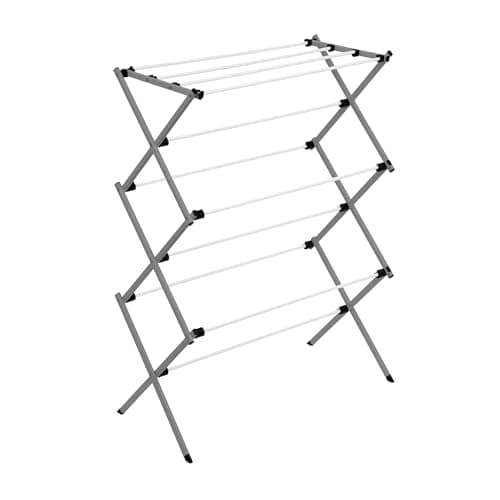 Honey-Can-Do 6-Tier Collapsible Steel Clothes Drying Rack, 24 ftTop pickThe best floor-to-line ratio of any rack here: 24 published feet of hanging on under three square feet of floor, and it folds to three inches. | Studios and dorms | 29"D x 14"W x 42"H | |
| 2 | 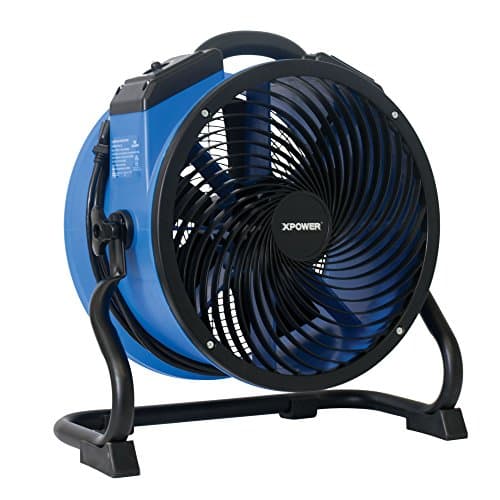 XPOWER FC-300 Air Mover / Whole Room Air Circulator2100 cfm on a published 100 W. That is more than seven times the airflow of a typical utility fan for the same power draw, and airflow is what dries laundry. | The fastest air over a rack | 18.6"D x 19.2"W x 9.4"H | |
| 3 | 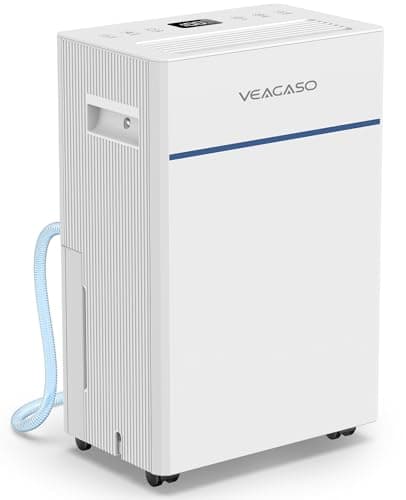 VEAGASO Dehumidifier, 28 Pints, 2000 Sq Ft28 pints a day on a published 158 W draw - the best pints-per-watt figure here, and quiet enough at 38 dB to run in a bedroom. | Drying a load overnight | 10.6"D x 6.7"W x 15.9"H | |
| 4 | 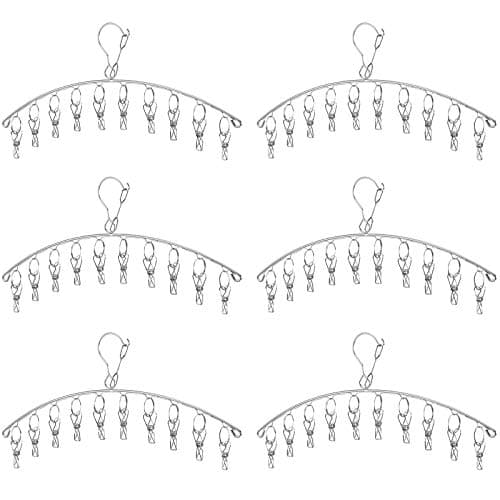 Seropy Clothes Hanger with 10 Clips, 6-PackSix stainless hangers, 60 clips total, on 4 mm wire with a locking windproof hook. The thing that stops small items eating a whole rack. | Socks and underwear | 16"L per hanger |
Most people arrive at this question having just moved into somewhere without a dryer. The good news is that it works fine and costs almost nothing. The bad news is that doing it badly takes two days and makes your apartment damp, and nothing tells you which you are doing until it has already happened.
Step 1: Get the water out before it reaches the rack
This is the step that matters most and the one nearly everyone skips. Water removed mechanically in the washer costs nothing extra and takes minutes; the same water removed by evaporation takes hours.
- Run a second spin cycle. On most machines this is a standalone option. It removes a noticeable amount of additional water for a few minutes of running time.
- Use the highest spin speed the fabric allows. Most cotton is fine at maximum; check the label for anything delicate.
- Do not overload the drum. An overloaded machine spins badly, and clothes come out much wetter.
- For a serious upgrade, a dedicated spin dryer at 1800 to 3200 RPM removes far more than a washer's own cycle - see spin dryers.
Step 2: Choose where it dries
Rank the rooms in your home by two things: how much air moves through them, and how much you care if they get humid.
| Room | Airflow | Suitability |
|---|---|---|
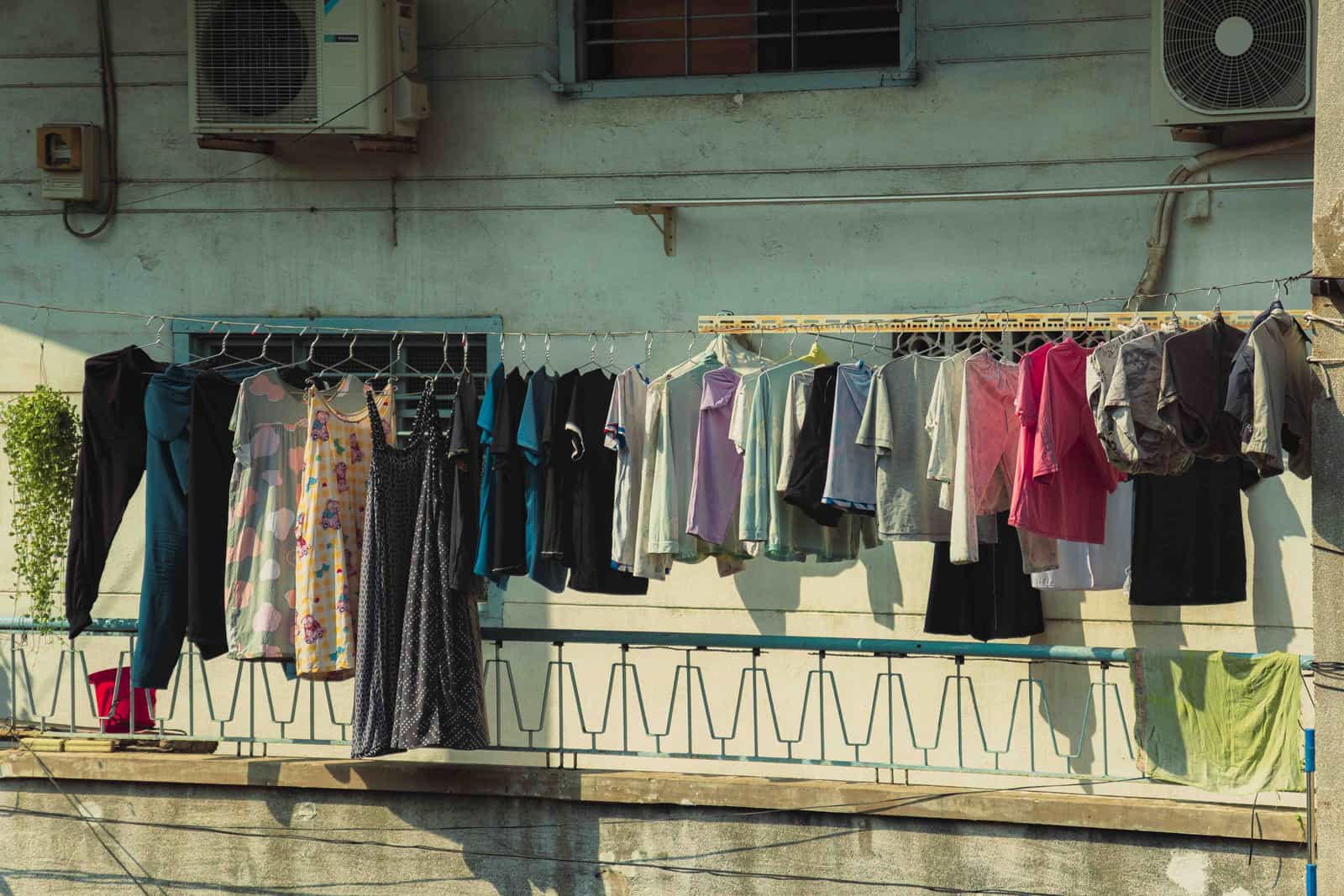
| Outdoors or a balcony | Excellent | Best by a distance - the sun is free |
| A warm room with a window ajar | Good | The realistic indoor best |
| A hallway or spare room | Moderate | Good if the door stays open |
| A bathroom with the extractor on | Moderate | Right for drips, poor for finishing |
| A closed bedroom | Poor | Avoid - you sleep in that humidity |
| A closed bathroom | Very poor | Slowest option, and where the smell starts |
Step 3: Load the rack properly
Spacing is the whole technique. Where two wet garments touch, neither surface is exposed, and the contact patch stays wet long after the rest of the load is dry. Heavy items go on the outer bars where air moves most, small items go onto clip hangers so they stop consuming bar length, and long items go on the top rail so hems clear the floor. The full detail is on how to load a drying rack.
Step 4: Move some air
This is the cheapest big improvement available. A fan placed low and angled up through the rack passes air over both faces of every garment. A 100 W fan for eight hours costs about 15 cents at the current US average rate, and it commonly halves drying time.
Step 5: Deal with the moisture
A washer load holds roughly two to five pints of water and every drop of it ends up in your home's air. In summer with a window open that is a non-event. In winter with everything closed, it condenses on the coldest surface in the room, and that is how apartments end up with mold around window frames.
Ventilate while drying, or run a dehumidifier in a closed room. The dehumidifier is the better answer in winter, and it costs about 23 cents a session. Details on indoor humidity and condensation.
How long to expect
| Item | Still air | With a fan | With a fan and a dehumidifier |
|---|---|---|---|
| T-shirt | 6-10 h | 3-5 h | 2-4 h |
| Dress shirt | 8-12 h | 4-6 h | 3-5 h |
| Jeans | 18-30 h | 10-16 h | 8-12 h |
| Bath towel | 16-28 h | 9-15 h | 7-11 h |
| Sweater, dried flat | 24-40 h | 14-22 h | 10-18 h |
Those ranges are wide because rooms differ enormously. The methodology and the assumptions behind them are on how long does air-drying take.
What it costs, all in
| Setup | Cost per load |
|---|---|
| Rack alone, window open | 0¢ |
| Rack plus a fan for 8 h | 15¢ |
| Rack plus a dehumidifier for 8 h | 23¢ |
| Rack, fan and dehumidifier | 38¢ |
| Electric tumble dryer, for comparison | 46¢ |
What to buy, in order
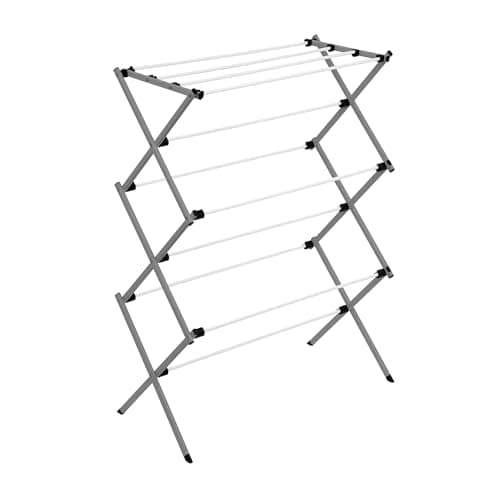
Top pick · Studios and dorms
Honey-Can-Do 6-Tier Collapsible Steel Clothes Drying Rack, 24 ft
The best floor-to-line ratio of any rack here: 24 published feet of hanging on under three square feet of floor, and it folds to three inches.
What the manufacturer publishes
- Open
- 29"D x 14"W x 42"H
- Folded
- Folds to 3 inches wide (full folded dimensions not published)
- Drying line
- 24 linear feet across 6 tiers
- Load capacity
- 50 lb
- Material
- Coated steel
Figures from Manufacturer listing on Amazon, retrieved 2026-09-12.
Under three square feet of floor, and 24 published feet of line: 8.5 feet of line per square foot. The Honey-Can-Do gullwing manages 4.9. That ratio is the whole argument for a tiered accordion rack in a small home.
Three inches folded is the number that matters in a rental, and it is published - which in this category is rare. Three inches fits behind an interior door or between a washer and a wall; a gullwing folded to eight or ten inches does not.
The trade-off is bar length. Six tiers of short bars suit shirts, underwear and socks; a bath towel hung at full width drapes over two tiers and slows both of them down.
Good
- 24 linear feet from under three square feet of floor
- Folds to a published 3 inches
- 50 lb rated capacity from a 4.8 lb frame
- Coated steel rods, which survive a damp room better than a bare finish
Not so good
- Short bars - full-size towels and sheets do not hang cleanly
- Six stacked tiers mean the lower rows dry slowest without air movement
- Only the folded width is published, not the full folded dimensions
Skip this if you are mostly drying towels and bedding. Long, heavy items want a wide gullwing, not a stack of short tiers.
#ad · how this is funded · price as of October 16, 2026
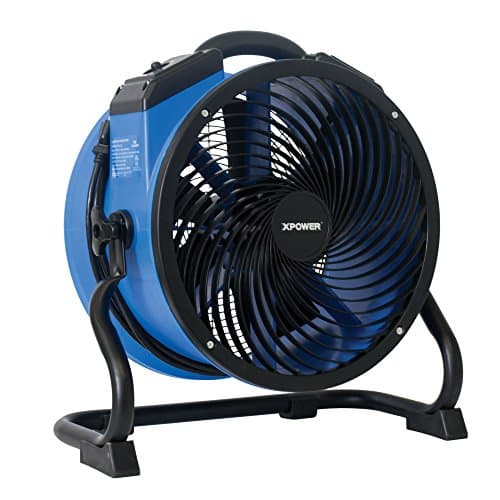
Pick 2 · The fastest air over a rack
XPOWER FC-300 Air Mover / Whole Room Air Circulator
2100 cfm on a published 100 W. That is more than seven times the airflow of a typical utility fan for the same power draw, and airflow is what dries laundry.
What the manufacturer publishes
- Open
- 18.6"D x 19.2"W x 9.4"H
- Folded
- Not applicable
- Drying line
- Not applicable
- Load capacity
- 2100 cfm
- Material
- Housing with high-torque induction motor
- Rated wattage
- 100 W
Costs 1.8¢ an hour to run - 9.2¢ for a 5-hour session, at 18.34¢/kWh (US residential average, June 2026).
Figures from Manufacturer listing on Amazon, retrieved 2026-09-02.
2100 cfm at 100 W is the specification that matters. Air movement is the single biggest lever on indoor drying time, and this delivers the most of it per watt of anything here.
One hundred watts for four hours is about 7 cents at the current US average rate. Running a fan alongside an unheated rack is close to the cheapest intervention available.
The three-hour timer means you can start it when you hang the load and not think about it, which is how it ends up actually getting used.
It is a floor blower, so it is directional. Aim it along the length of the rack, not at one garment.
Good
- 2100 cfm - by far the most airflow here
- 100 W published
- 3-hour timer
- Four speeds
Not so good
- Loud at full speed - this is shop equipment
- 13 lb and 18 inches across
- Directional, so placement matters
Skip this if the rack is in a bedroom you sleep in. A 2100 cfm air mover is not a quiet appliance.
#ad · how this is funded · price as of October 16, 2026
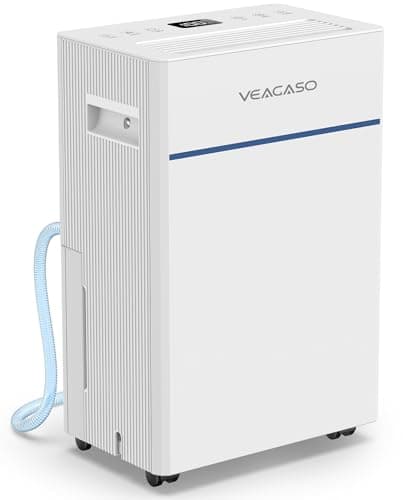
Pick 3 · Drying a load overnight
VEAGASO Dehumidifier, 28 Pints, 2000 Sq Ft
28 pints a day on a published 158 W draw - the best pints-per-watt figure here, and quiet enough at 38 dB to run in a bedroom.
What the manufacturer publishes
- Open
- 10.6"D x 6.7"W x 15.9"H
- Folded
- Not applicable
- Drying line
- Not applicable
- Load capacity
- 28 pints per day
- Material
- Compressor dehumidifier
- Rated wattage
- 158 W
Costs 2.9¢ an hour to run - 14.5¢ for a 5-hour session, at 18.34¢/kWh (US residential average, June 2026).
Figures from Manufacturer listing on Amazon, retrieved 2026-09-02.
A dehumidifier does not blow air at your laundry; it removes the water your laundry has just put into the room. That is why it dries a closed room full of washing and a fan does not.
158 W is the number to compare against a heated rack. Running it for eight hours costs about 23 cents at the current US average rate - roughly what a 270 W heated rack costs for five.
38 dB is quiet enough to sleep through, which matters because the natural way to use one is overnight in a closed room with the rack.
This is a compressor unit, not a thermoelectric one, which is why it can pull 28 pints where the small desktop units manage a fraction of that.
Good
- 158 W published - the running cost is calculable
- 28 pints per day
- 38 dB quiet mode
- 16.5 lb, portable between rooms
Not so good
- 35.3 cfm airflow is modest, so it works best in a closed room
- Compressor units lose capacity in a cold room
- Tank needs emptying or a hose run
Skip this if your drying room is under about 60 F. Compressor dehumidifiers slow down badly in the cold - that is a physics limit, not a brand problem.
#ad · how this is funded · price as of October 16, 2026
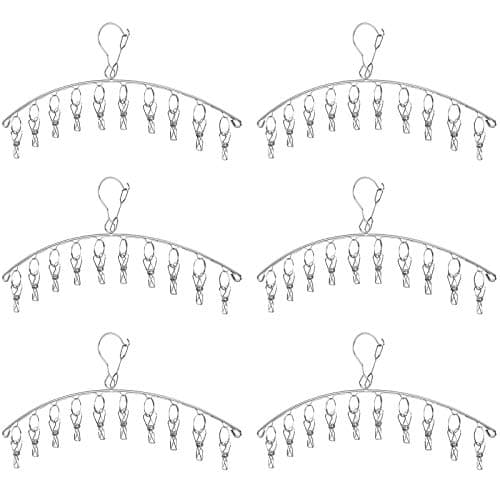
Pick 4 · Socks and underwear
Seropy Clothes Hanger with 10 Clips, 6-Pack
Six stainless hangers, 60 clips total, on 4 mm wire with a locking windproof hook. The thing that stops small items eating a whole rack.
What the manufacturer publishes
- Open
- 16"L per hanger
- Folded
- Not applicable
- Drying line
- 60 clips across 6 hangers
- Load capacity
- Not published
- Material
- Stainless steel, 4 mm wire
Figures from Manufacturer listing on Amazon, retrieved 2026-09-02.
Small items are what actually fills a rack. Sixty clips move every sock, every pair of underwear and every bra off the rack bars and into vertical space that was empty.
4 mm solid stainless rather than plated wire. Plated clip hangers rust at the clip spring first and then mark the next white shirt you hang on them.
The locking hook matters on a balcony or by an open window, where an unlocked hanger of socks becomes a neighbor's problem.
Good
- 60 clips for the price of one rack accessory
- Solid stainless, no plating to fail
- Locking windproof hook
- Hangs off a rod, a rack or a rail
Not so good
- No published weight rating
- Metal clips can mark very delicate fabrics
Skip this if you hand-wash a lot of fine knitwear. Metal clips leave a mark; a flat mesh dryer does not.
#ad · how this is funded · price as of October 16, 2026
If you are weighing whether to buy anything at all, the arithmetic is worth seeing first: a tumble dryer load is about 46 cents and a rack replaces it entirely. The full break-even, and the three costs that are not money, are on are drying racks worth it.
Common questions
How do you dry clothes without a dryer or a clothesline?
A folding rack indoors, with the load spun twice, garments spaced apart and a fan moving air through it. That handles a full load overnight in a normal heated room.
How long do clothes take to dry indoors?
A t-shirt is typically 6 to 10 hours in still air and 3 to 5 with a fan. Jeans and towels are much longer - 18 to 30 hours still, roughly halved with air movement.
Does drying clothes indoors cause damp?
It adds two to five pints of water to your air per load. In a ventilated room that disperses; in a closed room in winter it condenses on cold surfaces, which is a mold risk over time.
What is the cheapest way to dry clothes without a dryer?
A rack and an open window, which costs nothing. Adding a fan costs about 15 cents a load and roughly halves the time, which is the best value upgrade in this whole category.
Can you dry clothes indoors in an apartment?
Yes, and most renters do. The two things to get right are airflow and moisture - see apartment laundry without a dryer for the small-space version.
Sources
- U.S. Energy Information Administration - Electric Power Monthly, Table 5.3 (average residential price of electricity) - retrieved 2026-09-02
- U.S. Environmental Protection Agency - Mold Course, moisture and indoor relative humidity - retrieved 2026-09-02
- ENERGY STAR - Clothes Dryers product criteria and energy use - retrieved 2026-09-02
- Manufacturer listing on Amazon - retrieved 2026-09-02
Read next

The best clothes drying racks for an apartment
Six standing racks ranked on published specs rather than adjectives, with the one we would not buy named and explained.
How long does it take clothes to air dry?
A reference table of indoor drying times by garment and by room condition, with the assumptions behind every figure stated.

Apartment laundry without a dryer
A complete drying setup for a small rental, from the rack to the humidity, assuming no dryer and no holes in the walls.

What a heated drying rack actually costs to run
The calculator and the arithmetic: per hour, per session and per month, at a cited US electricity rate, against a tumble dryer.

Drying clothes indoors, humidity and condensation
Where the water from indoor drying actually goes, what humidity level to aim for, and how to avoid the condensation that follows.
The best fans for drying clothes
Three fans compared on airflow per watt and noise level, with running cost per load and where to place one.