Drying clothes indoors, humidity and condensation
A washer load carries two to five pints of water, and indoor drying puts every drop of it into your home.
We have not tested these products and we do not pretend to have. Here is what we did instead. Links to Amazon earn us a commission at no extra cost to you - disclosure.

| # | Rack | Best for | Open footprint | Price |
|---|---|---|---|---|
| 1 | 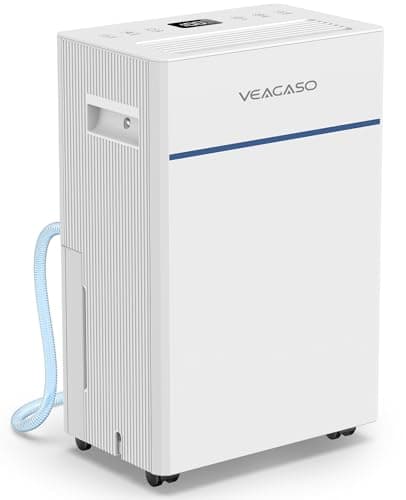 VEAGASO Dehumidifier, 28 Pints, 2000 Sq FtTop pick28 pints a day on a published 158 W draw - the best pints-per-watt figure here, and quiet enough at 38 dB to run in a bedroom. | Drying a load overnight | 10.6"D x 6.7"W x 15.9"H | |
| 2 | 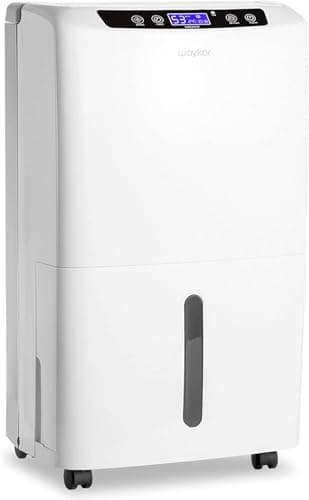 Waykar 34 Pint Energy Star Dehumidifier, 2000 Sq Ft34 pints a day across 2,000 square feet with a 90 degree aimable vent, from the one unit here sized for a flat rather than a room - and it publishes no wattage. | A whole damp apartment | 12.08"D x 8.46"W x 19.84"H |
This is the part of indoor drying nobody mentions when they tell you to save money by skipping the dryer. The water has to go somewhere, and indoors, somewhere is your home.
How much water is involved
A washer load leaves the drum holding roughly two to five pints of water depending on load size, fabric type and spin speed. Denim and towels are at the top of that range; a light load of shirts is at the bottom.
Where it goes
Water vapor moves through a home and condenses wherever it meets a surface cold enough. In practice that means, in order: single-glazed windows and window reveals, external wall corners, behind furniture pushed against an outside wall, and inside closets on external walls.
Those are the places to check. If any of them shows water, black spotting or a musty smell, the indoor drying is contributing to it.
What humidity to aim for
US health and environmental agencies broadly recommend keeping indoor relative humidity below about 50 percent to control mold and dust mites, with 30 to 50 percent the usual comfort range. A cheap hygrometer costs a few dollars and takes the guesswork out entirely.
| Relative humidity | Feels like | Drying speed | Risk |
|---|---|---|---|
| Below 30% | Dry - static, dry skin | Fast | Comfort, not moisture |
| 30-50% | Comfortable | Good | The target range |
| 50-60% | Slightly humid | Slowing | Watch cold surfaces |
| 60-70% | Noticeably humid | Slow | Condensation likely in winter |
| Above 70% | Muggy, windows wet | Very slow | Mold risk on cold surfaces |
The three ways to deal with it
- Ventilate. An open window, a trickle vent or an extractor fan lets the moisture leave. Free, and ideal in mild weather.
- Dehumidify. A dehumidifier collects the same water into a tank you pour away. About 23 cents a load, and the right answer in winter when opening a window is not realistic.
- Dry somewhere else. A balcony, a shared laundry room, or outdoors. Free and best of all, if you have the option.
What does not work is drying in a closed room and hoping. That is the arrangement that produces condensation, and adding heat to it makes the moisture enter the air faster rather than removing any of it.
Signs it has gone too far
- Windows running with water in the morning after a drying day.
- Black spotting in window reveals, on sealant, or in ceiling corners.
- A musty smell in a closet or behind furniture on an outside wall.
- Wallpaper lifting or paint blistering on an exterior wall.
- Laundry taking noticeably longer than it used to - the room is saturated.
Any of those means the moisture load exceeds what the room can shed. The fix is ventilation or dehumidification, not a different rack.
What to use
Top pick · Drying a load overnight
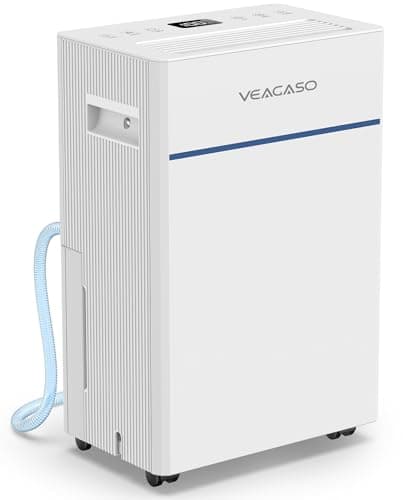
VEAGASO Dehumidifier, 28 Pints, 2000 Sq Ft
28 pints a day on a published 158 W draw - the best pints-per-watt figure here, and quiet enough at 38 dB to run in a bedroom.
What the manufacturer publishes
- Open
- 10.6"D x 6.7"W x 15.9"H
- Folded
- Not applicable
- Drying line
- Not applicable
- Load capacity
- 28 pints per day
- Material
- Compressor dehumidifier
- Rated wattage
- 158 W
Costs 2.9¢ an hour to run - 14.5¢ for a 5-hour session, at 18.34¢/kWh (US residential average, June 2026).
Figures from Manufacturer listing on Amazon, retrieved 2026-09-02.
A dehumidifier does not blow air at your laundry; it removes the water your laundry has just put into the room. That is why it dries a closed room full of washing and a fan does not.
158 W is the number to compare against a heated rack. Running it for eight hours costs about 23 cents at the current US average rate - roughly what a 270 W heated rack costs for five.
38 dB is quiet enough to sleep through, which matters because the natural way to use one is overnight in a closed room with the rack.
This is a compressor unit, not a thermoelectric one, which is why it can pull 28 pints where the small desktop units manage a fraction of that.
Good
- 158 W published - the running cost is calculable
- 28 pints per day
- 38 dB quiet mode
- 16.5 lb, portable between rooms
Not so good
- 35.3 cfm airflow is modest, so it works best in a closed room
- Compressor units lose capacity in a cold room
- Tank needs emptying or a hose run
Skip this if your drying room is under about 60 F. Compressor dehumidifiers slow down badly in the cold - that is a physics limit, not a brand problem.
#ad · how this is funded · price as of October 16, 2026
Pick 2 · A whole damp apartment
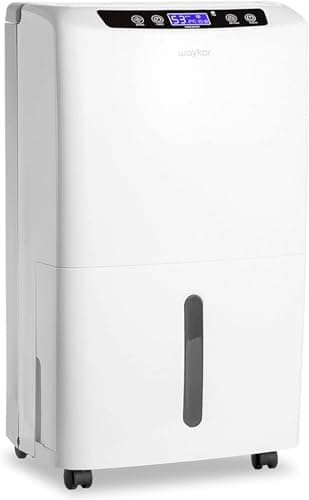
Waykar 34 Pint Energy Star Dehumidifier, 2000 Sq Ft
34 pints a day across 2,000 square feet with a 90 degree aimable vent, from the one unit here sized for a flat rather than a room - and it publishes no wattage.
What the manufacturer publishes
- Open
- 12.08"D x 8.46"W x 19.84"H
- Folded
- Not applicable
- Drying line
- Not applicable
- Load capacity
- 34 pints per day (at 95 F, 90% RH)
- Material
- Compressor dehumidifier, Energy Star certified
- Rated wattage
- not published
No wattage published. Waykar publishes a 34 pint rating, an Energy Star listing and a 2,000 sq ft coverage figure, but no rated wattage anywhere on the current listing. No running cost can be computed from a pint rating, so none is published here.
Figures from Manufacturer listing on Amazon, retrieved 2026-10-03.
The 34 pint rating is quoted at 95 F and 90% relative humidity, which is the industry test condition and not your apartment. Every dehumidifier's headline pint figure is quoted this way; expect less in a real room. Waykar at least states the conditions.
The 90 degree manual airflow swing is the feature worth having for laundry specifically - it lets you aim the dry outlet air at the rack, which turns the unit into a dehumidifier and a directional fan at once.
No rated wattage is published, so this site publishes no running cost for it. That is a real step down from the VEAGASO, which states 158 W and is therefore the only dehumidifier here whose cost per session can be calculated at all.
Humidity control runs 30% to 80% in 5% steps with a 3% hysteresis band, there is auto-defrost and a 24 hour timer, and it takes either the 0.66 gallon tank or a continuous hose. At 34 pints a day the tank is about four empties, so plan on the hose.
Good
- 34 pints a day with the test conditions stated
- Adjustable 90 degree airflow direction, aimable at a rack
- Energy Star certified, rated for 2,000 sq ft
- Dual drainage - 0.66 gallon tank or continuous hose
Not so good
- No published wattage, so no running cost can be computed
- No published airflow figure in cfm
- Headline pint rating is a test-condition figure, not a room figure
- Warranty is one year, extended to two only on registration
Skip this if you want to know what it costs to run. The VEAGASO publishes 158 W and this publishes nothing, which on a unit that runs for eight hours at a time is the specification that matters most.
#ad · how this is funded · price as of October 16, 2026
Common questions
Does drying clothes indoors cause damp?
It adds two to five pints of water to your air per load. In a ventilated room that disperses. In a closed room in winter it condenses on cold windows and exterior walls, which over time is a mold risk.
Can drying clothes indoors cause health problems?
The moisture itself does not, but sustained high indoor humidity encourages mold and dust mites, both of which affect respiratory health. US agencies broadly recommend keeping relative humidity below about 50 percent.
How much water does drying clothes put into the air?
Roughly two to five pints per washer load, depending on load size, fabric and spin speed. Three loads a week is over a gallon of water into your home.
What humidity should a house be at?
Broadly 30 to 50 percent relative humidity. Above 60 percent, condensation on cold surfaces becomes likely in winter and mold risk rises.
Does a dehumidifier stop condensation from drying clothes?
Yes, that is exactly what it does - it collects the water into a tank instead of letting it condense on your windows and walls, while also keeping the laundry drying.
Sources
- U.S. Environmental Protection Agency - Mold Course, moisture and indoor relative humidity - retrieved 2026-09-02
- U.S. Environmental Protection Agency - A Brief Guide to Mold, Moisture and Your Home - retrieved 2026-09-02
- ASHRAE Standard 55 - thermal environmental conditions, including recommended indoor humidity - retrieved 2026-09-02
- Manufacturer listing on Amazon - retrieved 2026-10-03
Read next
The best dehumidifiers for drying clothes
Four dehumidifiers ranked on published extraction, wattage and airflow, with cost per drying session computed.

How to dry clothes indoors in winter
Why indoor drying stalls in winter, what to change, and how to avoid the condensation that comes with a closed-up home.
Heated drying rack vs dehumidifier
Running cost, mechanism and effect on room humidity for the two main ways of speeding up indoor drying.
How to air-dry clothes inside without the smell
Why indoor-dried laundry goes musty, the four things that prevent it, and how to rescue clothes that already smell.
What size dehumidifier do you need for drying clothes?
A sizing table by room size and dampness in US pints, plus how to read the pint ratings manufacturers publish.
Drying clothes in a bathroom
How to use a bathroom for drying without slowing everything down, and which rack materials survive permanently damp air.