What size dehumidifier do you need for drying clothes?
Sized in US pints per day, with the conversion from the liter figures the UK guides quote.
We have not tested these products and we do not pretend to have. Here is what we did instead. Links to Amazon earn us a commission at no extra cost to you - disclosure.
| # | Rack | Best for | Open footprint | Price |
|---|---|---|---|---|
| 1 | 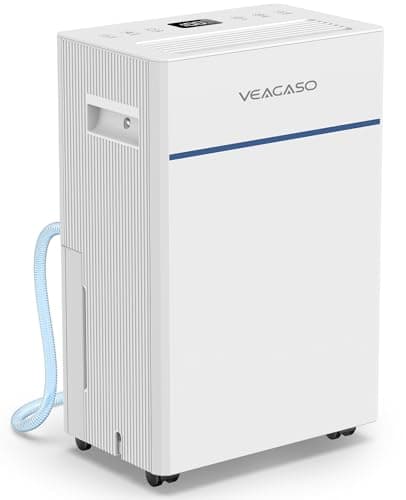 VEAGASO Dehumidifier, 28 Pints, 2000 Sq FtTop pick28 pints a day on a published 158 W draw - the best pints-per-watt figure here, and quiet enough at 38 dB to run in a bedroom. | Drying a load overnight | 10.6"D x 6.7"W x 15.9"H | |
| 2 | 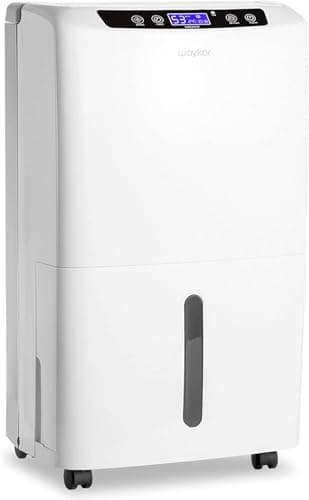 Waykar 34 Pint Energy Star Dehumidifier, 2000 Sq Ft34 pints a day across 2,000 square feet with a 90 degree aimable vent, from the one unit here sized for a flat rather than a room - and it publishes no wattage. | A whole damp apartment | 12.08"D x 8.46"W x 19.84"H | |
| 3 | 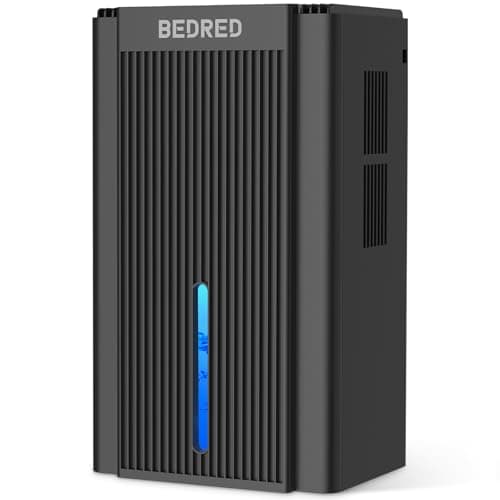 BEDRED Dehumidifier, 95 oz Tank, 1000 Sq FtA thermoelectric unit at a published 85 W. Quieter and cheaper to run than a compressor, and it pulls a fraction of the water. | A small closed room | 6.7"D x 8.7"W x 14.6"H |
Dehumidifier sizing is quoted in pints per day in the US and liters per day nearly everywhere else, which is why the best written guidance on this question is in units US buyers cannot shop with. Here it is in pints, with the conversion.
The sizing table
| Space | Slightly damp | Moderately damp | Very damp |
|---|---|---|---|
| One room, up to 500 sq ft | 20 pints | 20-25 pints | 25-30 pints |
| Studio or 1-bed, up to 1,000 sq ft | 20-25 pints | 25-30 pints | 30-35 pints |
| 2-bed apartment, up to 1,500 sq ft | 25-30 pints | 30-35 pints | 35-45 pints |
| Whole home, 2,000 sq ft and up | 30-35 pints | 35-45 pints | 45-50+ pints |
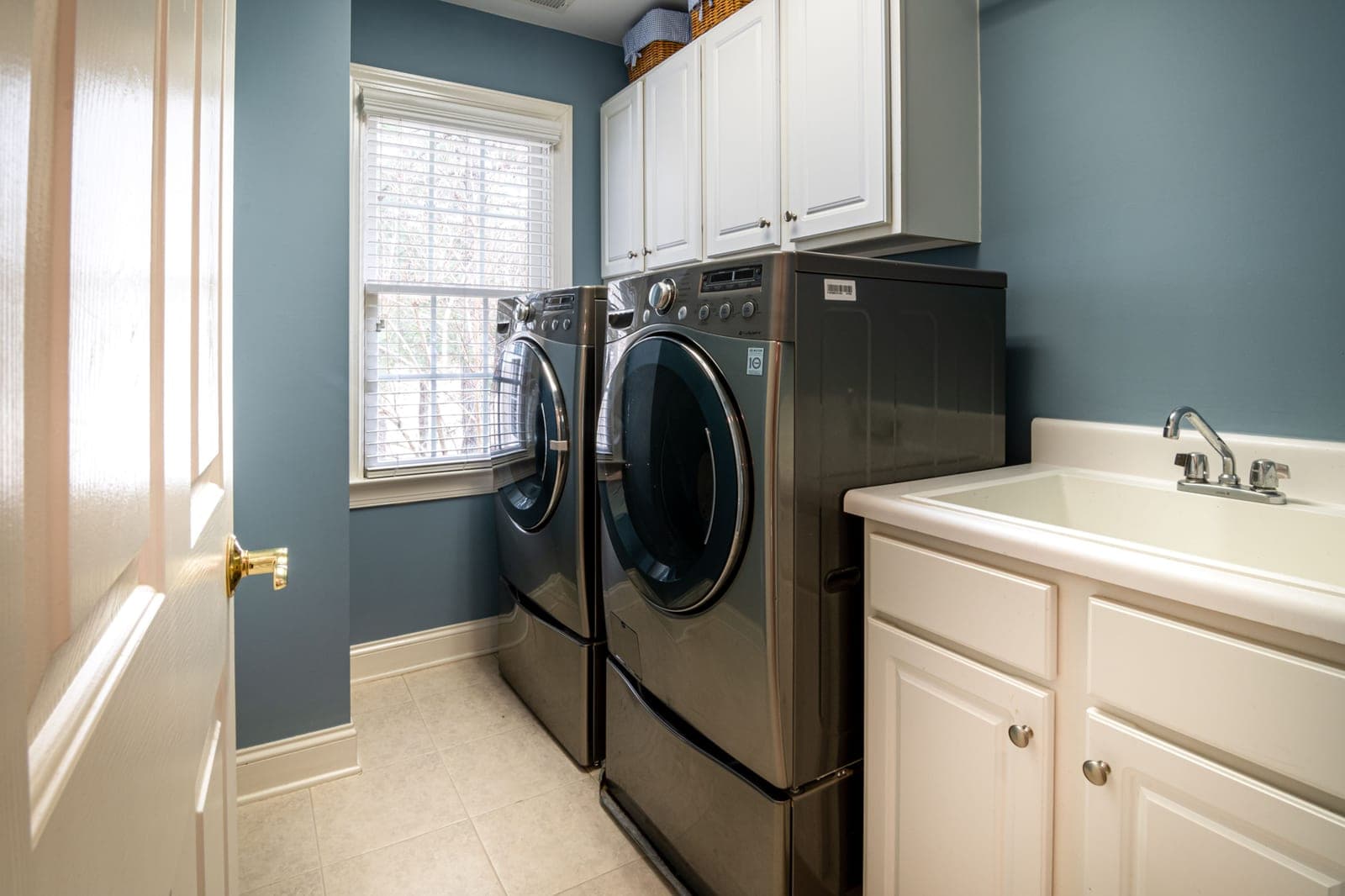
For laundry specifically, size to the room the rack is in rather than to your whole home, because you close the door and run it in that room. That is why a 28 pint unit is enough for most apartment drying even though the apartment as a whole would suggest a larger one.
The conversion from liters
| Liters/day (UK and EU rating) | US pints/day | Roughly equivalent US model |
|---|---|---|
| 10 L | 21 pints | 20-pint |
| 12 L | 25 pints | 25-pint |
| 16 L | 34 pints | 30-35 pint |
| 20 L | 42 pints | 40-45 pint |
| 25 L | 53 pints | 50-pint |
How to read a pint rating honestly
This is the part that matters. A dehumidifier's headline pint figure is measured under test conditions - one unit here publishes its 34 pint rating at 95 F and 90 percent relative humidity, and states so. Your apartment is not at 95 F and 90 percent.
In a normal heated room at moderate humidity, expect meaningfully less than the headline figure. That is not a manufacturer being dishonest; it is a standard test condition, applied consistently, which makes the numbers comparable between units even though none of them describes your room.
How much you actually need to remove
The other three specifications
- Wattage - sets the running cost, and only one unit here publishes it: 158 W, which is 23 cents for an eight-hour session. For every other dehumidifier on this site no running cost can be computed at all.
- Airflow in cfm - a unit moving more air also does part of a fan's job. Only one unit here publishes a figure, at 35.3 cfm.
- Noise in dB - 38 dB is bedroom-quiet, 45 dB is noticeable but tolerable overnight.
- Drainage - a continuous hose option means you never come back to a full tank and a stalled dry.
The picks by size
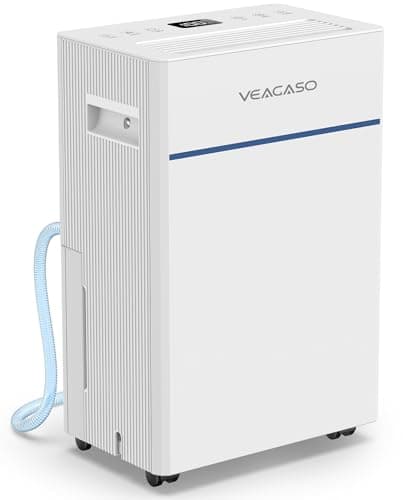
Top pick · Drying a load overnight
VEAGASO Dehumidifier, 28 Pints, 2000 Sq Ft
28 pints a day on a published 158 W draw - the best pints-per-watt figure here, and quiet enough at 38 dB to run in a bedroom.
What the manufacturer publishes
- Open
- 10.6"D x 6.7"W x 15.9"H
- Folded
- Not applicable
- Drying line
- Not applicable
- Load capacity
- 28 pints per day
- Material
- Compressor dehumidifier
- Rated wattage
- 158 W
Costs 2.9¢ an hour to run - 14.5¢ for a 5-hour session, at 18.34¢/kWh (US residential average, June 2026).
Figures from Manufacturer listing on Amazon, retrieved 2026-09-02.
A dehumidifier does not blow air at your laundry; it removes the water your laundry has just put into the room. That is why it dries a closed room full of washing and a fan does not.
158 W is the number to compare against a heated rack. Running it for eight hours costs about 23 cents at the current US average rate - roughly what a 270 W heated rack costs for five.
38 dB is quiet enough to sleep through, which matters because the natural way to use one is overnight in a closed room with the rack.
This is a compressor unit, not a thermoelectric one, which is why it can pull 28 pints where the small desktop units manage a fraction of that.
Good
- 158 W published - the running cost is calculable
- 28 pints per day
- 38 dB quiet mode
- 16.5 lb, portable between rooms
Not so good
- 35.3 cfm airflow is modest, so it works best in a closed room
- Compressor units lose capacity in a cold room
- Tank needs emptying or a hose run
Skip this if your drying room is under about 60 F. Compressor dehumidifiers slow down badly in the cold - that is a physics limit, not a brand problem.
#ad · how this is funded · price as of October 16, 2026
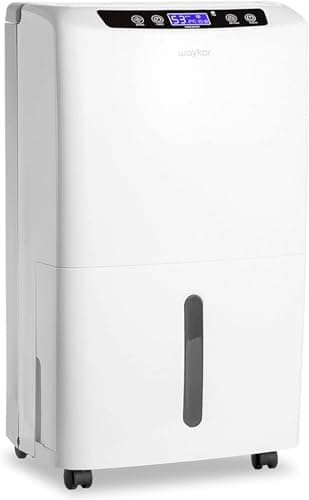
Pick 2 · A whole damp apartment
Waykar 34 Pint Energy Star Dehumidifier, 2000 Sq Ft
34 pints a day across 2,000 square feet with a 90 degree aimable vent, from the one unit here sized for a flat rather than a room - and it publishes no wattage.
What the manufacturer publishes
- Open
- 12.08"D x 8.46"W x 19.84"H
- Folded
- Not applicable
- Drying line
- Not applicable
- Load capacity
- 34 pints per day (at 95 F, 90% RH)
- Material
- Compressor dehumidifier, Energy Star certified
- Rated wattage
- not published
No wattage published. Waykar publishes a 34 pint rating, an Energy Star listing and a 2,000 sq ft coverage figure, but no rated wattage anywhere on the current listing. No running cost can be computed from a pint rating, so none is published here.
Figures from Manufacturer listing on Amazon, retrieved 2026-10-03.
The 34 pint rating is quoted at 95 F and 90% relative humidity, which is the industry test condition and not your apartment. Every dehumidifier's headline pint figure is quoted this way; expect less in a real room. Waykar at least states the conditions.
The 90 degree manual airflow swing is the feature worth having for laundry specifically - it lets you aim the dry outlet air at the rack, which turns the unit into a dehumidifier and a directional fan at once.
No rated wattage is published, so this site publishes no running cost for it. That is a real step down from the VEAGASO, which states 158 W and is therefore the only dehumidifier here whose cost per session can be calculated at all.
Humidity control runs 30% to 80% in 5% steps with a 3% hysteresis band, there is auto-defrost and a 24 hour timer, and it takes either the 0.66 gallon tank or a continuous hose. At 34 pints a day the tank is about four empties, so plan on the hose.
Good
- 34 pints a day with the test conditions stated
- Adjustable 90 degree airflow direction, aimable at a rack
- Energy Star certified, rated for 2,000 sq ft
- Dual drainage - 0.66 gallon tank or continuous hose
Not so good
- No published wattage, so no running cost can be computed
- No published airflow figure in cfm
- Headline pint rating is a test-condition figure, not a room figure
- Warranty is one year, extended to two only on registration
Skip this if you want to know what it costs to run. The VEAGASO publishes 158 W and this publishes nothing, which on a unit that runs for eight hours at a time is the specification that matters most.
#ad · how this is funded · price as of October 16, 2026
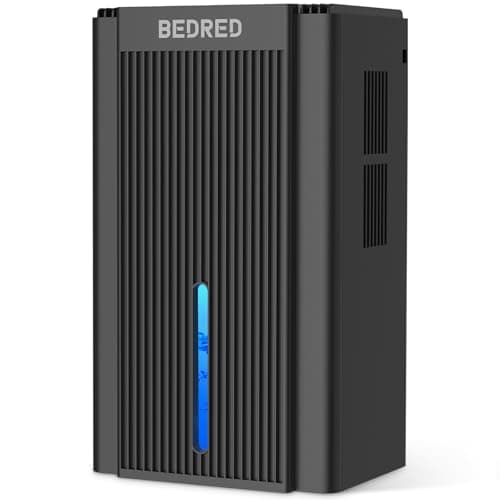
Pick 3 · A small closed room
BEDRED Dehumidifier, 95 oz Tank, 1000 Sq Ft
A thermoelectric unit at a published 85 W. Quieter and cheaper to run than a compressor, and it pulls a fraction of the water.
What the manufacturer publishes
- Open
- 6.7"D x 8.7"W x 14.6"H
- Folded
- Not applicable
- Drying line
- Not applicable
- Load capacity
- 95 oz tank
- Material
- Thermoelectric (Peltier) dehumidifier
- Rated wattage
- 85 W
Costs 1.6¢ an hour to run - 7.8¢ for a 5-hour session, at 18.34¢/kWh (US residential average, June 2026).
Figures from Manufacturer listing on Amazon, retrieved 2026-09-02.
Thermoelectric is a genuinely different technology, not a smaller compressor. It has no moving compressor, so it is near-silent, and it extracts far less water per hour.
The listing publishes a tank size, not a pints-per-day extraction rate. Those are not the same number and cannot be compared with the compressor units above.
85 W is real and low. For a small closed bathroom with one rack in it, this is enough. For a bedroom full of wet laundry it is not.
Good
- 85 W published - the cheapest to run here
- Near-silent, no compressor
- Small enough to sit on a shelf
- Auto shut-off when full
Not so good
- Publishes a tank size, not an extraction rate
- Thermoelectric units extract far less water than compressors
- Loses effectiveness in a cold room even faster than a compressor
Skip this if you are drying a full load in a bedroom. Buy a compressor unit and accept the noise - this is a bathroom-sized device.
#ad · how this is funded · price as of October 16, 2026
One reason pint ratings mislead: they are measured in a hot, nearly saturated room. One listing publishes those conditions outright, and what that means in a cool apartment is on the VEAGASO 28-pint review.
Common questions
What size dehumidifier do I need to dry clothes?
For one room and one load, 20 to 30 pints per day is plenty. Size to the room the rack is in, not to your whole home, because you close the door and run it in that room.
How many pints is 10 liters of dehumidifier capacity?
About 21 US pints. The conversion is liters times 2.113, which is worth knowing because much of the best guidance on this quotes liters.
Is a bigger dehumidifier better for drying clothes?
Not necessarily. A laundry load releases 2 to 5 pints, which even a 20-pint unit handles. Buy bigger for a damp home, not for a big wash.
Why does my dehumidifier collect less water than its rating?
Because the rating is measured at a standard test condition - one unit publishes its figure at 95 F and 90 percent humidity. Real rooms are cooler and drier, so real extraction is lower. The ratings are for comparing units, not for predicting your tank.
Sources
- Manufacturer listing on Amazon - retrieved 2026-10-03
- Manufacturer listing on Amazon - retrieved 2026-09-02
- U.S. Environmental Protection Agency - A Brief Guide to Mold, Moisture and Your Home - retrieved 2026-09-02
- U.S. Energy Information Administration - Electric Power Monthly, Table 5.3 (average residential price of electricity) - retrieved 2026-09-02
Read next
The best dehumidifiers for drying clothes
Four dehumidifiers ranked on published extraction, wattage and airflow, with cost per drying session computed.

Does a dehumidifier dry clothes?
How a dehumidifier speeds up drying without touching the laundry, and how to set a room up so it works properly.
Drying clothes indoors, humidity and condensation
Where the water from indoor drying actually goes, what humidity level to aim for, and how to avoid the condensation that follows.
Dehumidifier vs fan for drying clothes
Running cost, mechanism and the room condition that decides which of the two is the right purchase.

How to dry clothes indoors in winter
Why indoor drying stalls in winter, what to change, and how to avoid the condensation that comes with a closed-up home.