Dehumidifier vs fan for drying clothes
A fan needs somewhere for the moisture to go. A dehumidifier makes that somewhere itself.
We have not tested these products and we do not pretend to have. Here is what we did instead. Links to Amazon earn us a commission at no extra cost to you - disclosure.
| # | Rack | Best for | Open footprint | Price |
|---|---|---|---|---|
| 1 | 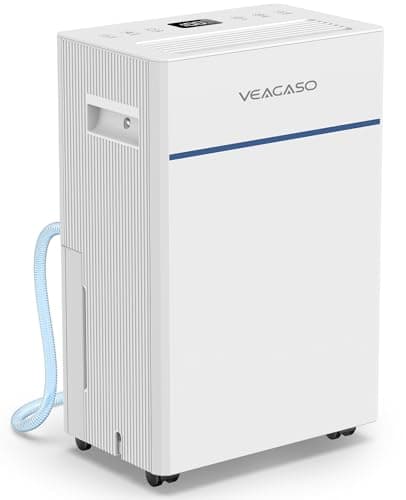 VEAGASO Dehumidifier, 28 Pints, 2000 Sq FtTop pick28 pints a day on a published 158 W draw - the best pints-per-watt figure here, and quiet enough at 38 dB to run in a bedroom. | Drying a load overnight | 10.6"D x 6.7"W x 15.9"H | |
| 2 | 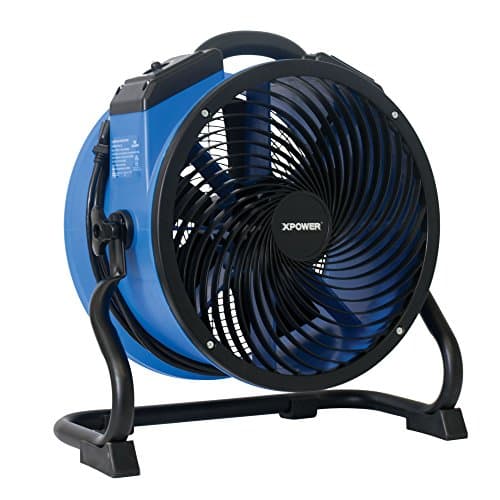 XPOWER FC-300 Air Mover / Whole Room Air Circulator2100 cfm on a published 100 W. That is more than seven times the airflow of a typical utility fan for the same power draw, and airflow is what dries laundry. | The fastest air over a rack | 18.6"D x 19.2"W x 9.4"H |
These two are the main purchases in this hub and they are often presented as alternatives. They are not really - they solve different halves of the same problem, and which half is binding depends entirely on your room.
What each one actually does
A fan moves air. It strips the saturated layer sitting against your wet laundry and replaces it with room air. It does not remove a single drop of water from your home - it relocates it into the room and relies on the room having somewhere to put it.
A dehumidifier removes water. It condenses moisture out of the room air into a tank. It moves comparatively little air, so it does much less to strip that saturated boundary layer, but it guarantees the room air always has capacity to accept more.
The decision table
| Fan | Dehumidifier | |
|---|---|---|
| Running cost, 8 h | 15¢ at 100 W | 23¢ at 158 W |
| Removes water from the home | No | Yes |
| Airflow | 289-2,100 cfm | 35.3 cfm, published on one unit |
| Works in a closed room | Only until the air saturates | Yes - that is the design case |
| Works in a ventilated room | Yes - the ideal case | Wasteful - it dries the outdoors |
| Helps with condensation and mold | No | Yes |
| Noise | Varies - 45 dB to loud | 38-45 dB |
| Needs emptying | No | Yes, or a drain hose |
| Useful year round | As a fan | As a damp control |
The deciding factor: is the room open or closed?
That is the whole question. In an open room the moisture leaves on its own, so the binding constraint is the boundary layer against the fabric - and a fan attacks exactly that. In a closed room the moisture has nowhere to go, so the room saturates and the fan's advantage disappears within hours; a dehumidifier attacks exactly that.
Choose by season, really
| Season | Room state | Use |
|---|---|---|
| Summer | Windows open | Fan |
| Spring and fall | Windows sometimes open | Fan, mostly |
| Winter | Everything closed | Dehumidifier |
| Any season, damp basement or bathroom | Closed and damp | Dehumidifier |
Running both
It is not silly, and it is the best arrangement in a closed room. The dehumidifier keeps the room air unsaturated; the fan makes sure that unsaturated air actually reaches the fabric rather than sitting still on the other side of the room. Together they are about 38 cents a session, still less than a tumble-dryer load.
The two products
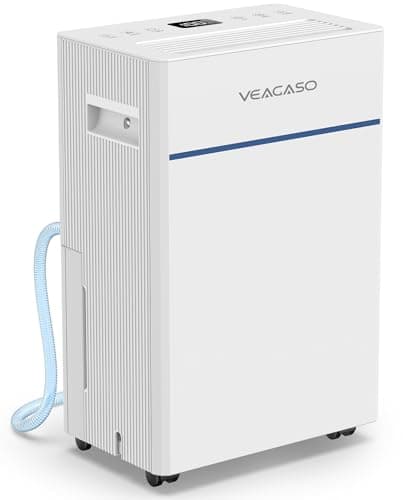
Top pick · Drying a load overnight
VEAGASO Dehumidifier, 28 Pints, 2000 Sq Ft
28 pints a day on a published 158 W draw - the best pints-per-watt figure here, and quiet enough at 38 dB to run in a bedroom.
What the manufacturer publishes
- Open
- 10.6"D x 6.7"W x 15.9"H
- Folded
- Not applicable
- Drying line
- Not applicable
- Load capacity
- 28 pints per day
- Material
- Compressor dehumidifier
- Rated wattage
- 158 W
Costs 2.9¢ an hour to run - 14.5¢ for a 5-hour session, at 18.34¢/kWh (US residential average, June 2026).
Figures from Manufacturer listing on Amazon, retrieved 2026-09-02.
A dehumidifier does not blow air at your laundry; it removes the water your laundry has just put into the room. That is why it dries a closed room full of washing and a fan does not.
158 W is the number to compare against a heated rack. Running it for eight hours costs about 23 cents at the current US average rate - roughly what a 270 W heated rack costs for five.
38 dB is quiet enough to sleep through, which matters because the natural way to use one is overnight in a closed room with the rack.
This is a compressor unit, not a thermoelectric one, which is why it can pull 28 pints where the small desktop units manage a fraction of that.
Good
- 158 W published - the running cost is calculable
- 28 pints per day
- 38 dB quiet mode
- 16.5 lb, portable between rooms
Not so good
- 35.3 cfm airflow is modest, so it works best in a closed room
- Compressor units lose capacity in a cold room
- Tank needs emptying or a hose run
Skip this if your drying room is under about 60 F. Compressor dehumidifiers slow down badly in the cold - that is a physics limit, not a brand problem.
#ad · how this is funded · price as of October 16, 2026
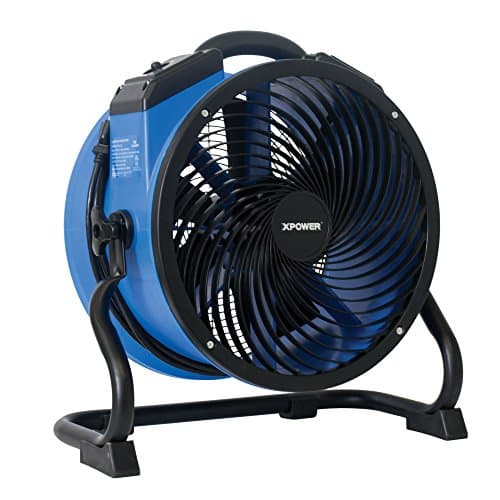
Pick 2 · The fastest air over a rack
XPOWER FC-300 Air Mover / Whole Room Air Circulator
2100 cfm on a published 100 W. That is more than seven times the airflow of a typical utility fan for the same power draw, and airflow is what dries laundry.
What the manufacturer publishes
- Open
- 18.6"D x 19.2"W x 9.4"H
- Folded
- Not applicable
- Drying line
- Not applicable
- Load capacity
- 2100 cfm
- Material
- Housing with high-torque induction motor
- Rated wattage
- 100 W
Costs 1.8¢ an hour to run - 9.2¢ for a 5-hour session, at 18.34¢/kWh (US residential average, June 2026).
Figures from Manufacturer listing on Amazon, retrieved 2026-09-02.
2100 cfm at 100 W is the specification that matters. Air movement is the single biggest lever on indoor drying time, and this delivers the most of it per watt of anything here.
One hundred watts for four hours is about 7 cents at the current US average rate. Running a fan alongside an unheated rack is close to the cheapest intervention available.
The three-hour timer means you can start it when you hang the load and not think about it, which is how it ends up actually getting used.
It is a floor blower, so it is directional. Aim it along the length of the rack, not at one garment.
Good
- 2100 cfm - by far the most airflow here
- 100 W published
- 3-hour timer
- Four speeds
Not so good
- Loud at full speed - this is shop equipment
- 13 lb and 18 inches across
- Directional, so placement matters
Skip this if the rack is in a bedroom you sleep in. A 2100 cfm air mover is not a quiet appliance.
#ad · how this is funded · price as of October 16, 2026
If the dehumidifier side wins for your room, the unit this site recommends is reviewed in full - including what it costs per hour - on the VEAGASO 28-pint review.
Common questions
Is a fan or a dehumidifier better for drying clothes?
A fan in a ventilated room, a dehumidifier in a closed one. The fan needs somewhere for the moisture to go; the dehumidifier makes that somewhere itself.
Can you use a fan and a dehumidifier together?
Yes, and in a closed room it is the best arrangement. The dehumidifier keeps the air unsaturated and the fan makes sure that air actually reaches the laundry. About 38 cents a session together.
Does a fan remove moisture from a room?
No. It moves air around and speeds evaporation from the fabric, but every drop still ends up in your room. Only a dehumidifier or ventilation removes it.
Which is cheaper to run, a fan or a dehumidifier?
A fan, slightly - about 15 cents for an eight-hour run against about 23 cents. The difference is small enough that the room condition should decide, not the cost.
Sources
- U.S. Energy Information Administration - Electric Power Monthly, Table 5.3 (average residential price of electricity) - retrieved 2026-09-02
- Manufacturer listing on Amazon - retrieved 2026-09-02
- Manufacturer listing on Amazon - retrieved 2026-09-02
- U.S. Environmental Protection Agency - Mold Course, moisture and indoor relative humidity - retrieved 2026-09-02
Read next
The best dehumidifiers for drying clothes
Four dehumidifiers ranked on published extraction, wattage and airflow, with cost per drying session computed.
The best fans for drying clothes
Three fans compared on airflow per watt and noise level, with running cost per load and where to place one.

Drying clothes indoors, humidity and condensation
Where the water from indoor drying actually goes, what humidity level to aim for, and how to avoid the condensation that follows.

How to dry clothes indoors in winter
Why indoor drying stalls in winter, what to change, and how to avoid the condensation that comes with a closed-up home.
Heated drying rack vs dehumidifier
Running cost, mechanism and effect on room humidity for the two main ways of speeding up indoor drying.