How to air-dry clothes without them getting stiff
It is not the drying. It is the lack of movement while drying, plus whatever your detergent left behind.
We have not tested these products and we do not pretend to have. Here is what we did instead. Links to Amazon earn us a commission at no extra cost to you - disclosure.
| # | Rack | Best for | Open footprint | Price |
|---|---|---|---|---|
| 1 | 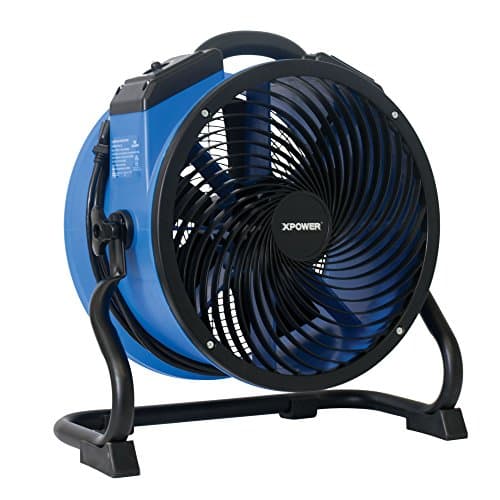 XPOWER FC-300 Air Mover / Whole Room Air CirculatorTop pick2100 cfm on a published 100 W. That is more than seven times the airflow of a typical utility fan for the same power draw, and airflow is what dries laundry. | The fastest air over a rack | 18.6"D x 19.2"W x 9.4"H | |
| 2 | 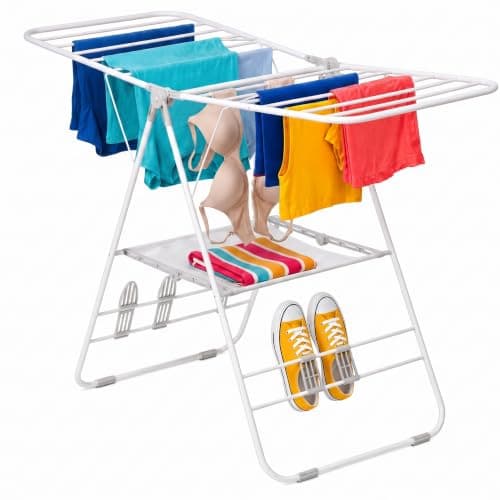 Honey-Can-Do Heavy-Duty Gullwing Clothes Drying Rack, 50 lb46 linear feet and a 50 lb rating - the rack that takes an entire load without a second trip, if you can spare the floor. | A full washer load in one go | 56.89"D x 23.82"W x 37.8"H |
The classic complaint about giving up a dryer is that towels come out like cardboard. It is real, it has two specific causes, and both are fixable without buying a machine.
Cause one: no agitation while drying
A tumble dryer keeps fabric moving the entire time it dries. Cotton loops on a towel get knocked apart repeatedly and set in a raised, fluffy position. On a rack the same loops dry exactly where the water leaves them - flat and interlocked - and that flat interlocked state is what stiffness feels like.
Nothing about the fabric has been damaged. Shake a stiff air-dried towel hard and it softens noticeably, immediately, which is the proof that this is mechanical rather than chemical.
Cause two: residue
Detergent that is not fully rinsed out stays in the fabric and hardens as the water evaporates. In hard-water areas, dissolved minerals do the same thing. A dryer's tumbling breaks that crust up mechanically; a rack does not, so residue that a dryer would have hidden becomes noticeable.
This is why the same load can be stiff at one address and fine at another with identical detergent.
The five fixes, in order of effect
- Use less detergent. Most people use substantially more than the dose on the pack requires, and the excess has to go somewhere. Halving it is the single most effective change for most households.
- Add an extra rinse cycle. Free on most machines, and it removes what the main rinse left. In hard water this is the fix.
- Shake each item hard before hanging. Ten seconds a garment. This is agitation, applied by hand, at the moment it matters.
- Shake again when dry, or fold briskly rather than gently. It works for the same reason.
- Add half a cup of white vinegar to the rinse. It helps dissolve mineral and detergent residue. It does not leave a smell once dry.
What about fabric softener
Fabric softener coats fibers to make them feel soft, and on towels it also reduces absorbency - which is the one thing a towel is for. On air-dried laundry it can add to the residue problem rather than solving it. Fixing the rinse is a better answer than adding another product to rinse out.
The airflow connection
Fabric that dries slowly in still air sets harder than fabric dried quickly in moving air, because the fibers have longer to settle into that flat interlocked position. A fan does not eliminate stiffness but it noticeably reduces it, which is a second reason to run one beyond the drying time.
| Fabric | Stiffness when air-dried | Best fix |
|---|---|---|
| Bath towels | Most affected | Less detergent, extra rinse, hard shake |
| Jeans and denim | Noticeable | Shake out, hang by the waistband |
| Cotton t-shirts | Slight | Shake before hanging |
| Bed sheets | Noticeable | Extra rinse, shake, fold from damp |
| Synthetics | Barely | Nothing needed |
| Wool and knitwear | Not applicable | Flat drying is the concern, not stiffness |
What helps
Top pick · The fastest air over a rack
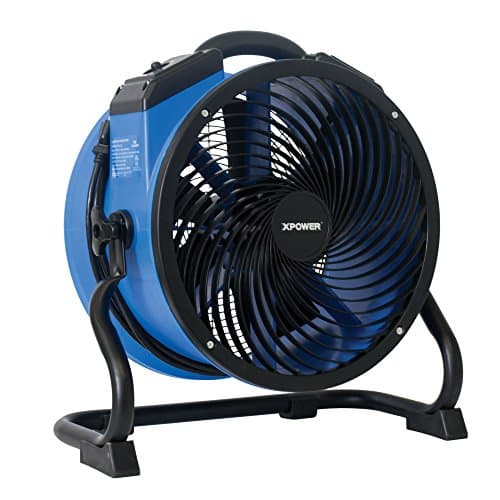
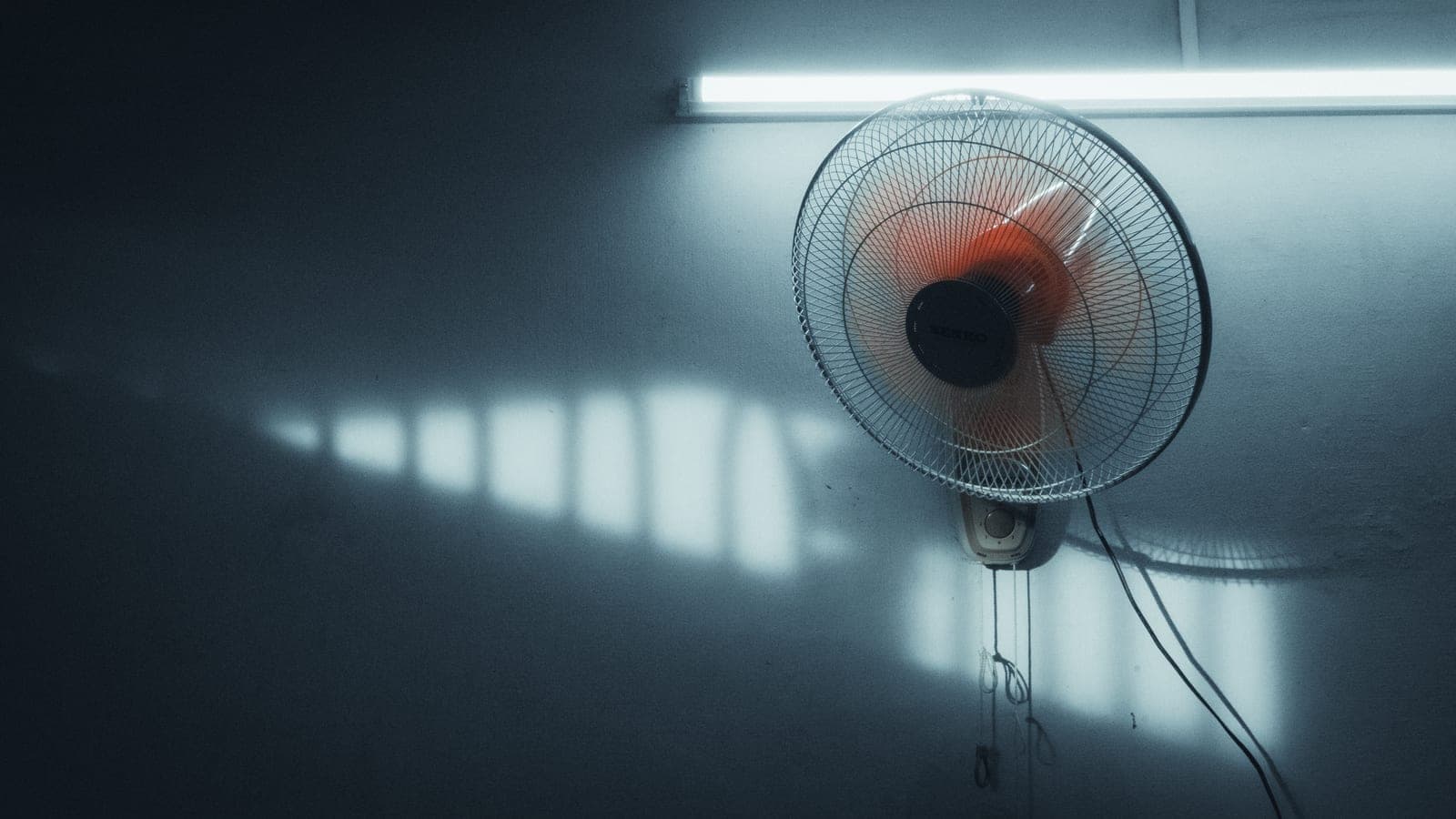
XPOWER FC-300 Air Mover / Whole Room Air Circulator
2100 cfm on a published 100 W. That is more than seven times the airflow of a typical utility fan for the same power draw, and airflow is what dries laundry.
What the manufacturer publishes
- Open
- 18.6"D x 19.2"W x 9.4"H
- Folded
- Not applicable
- Drying line
- Not applicable
- Load capacity
- 2100 cfm
- Material
- Housing with high-torque induction motor
- Rated wattage
- 100 W
Costs 1.8¢ an hour to run - 9.2¢ for a 5-hour session, at 18.34¢/kWh (US residential average, June 2026).
Figures from Manufacturer listing on Amazon, retrieved 2026-09-02.
2100 cfm at 100 W is the specification that matters. Air movement is the single biggest lever on indoor drying time, and this delivers the most of it per watt of anything here.
One hundred watts for four hours is about 7 cents at the current US average rate. Running a fan alongside an unheated rack is close to the cheapest intervention available.
The three-hour timer means you can start it when you hang the load and not think about it, which is how it ends up actually getting used.
It is a floor blower, so it is directional. Aim it along the length of the rack, not at one garment.
Good
- 2100 cfm - by far the most airflow here
- 100 W published
- 3-hour timer
- Four speeds
Not so good
- Loud at full speed - this is shop equipment
- 13 lb and 18 inches across
- Directional, so placement matters
Skip this if the rack is in a bedroom you sleep in. A 2100 cfm air mover is not a quiet appliance.
#ad · how this is funded · price as of October 16, 2026
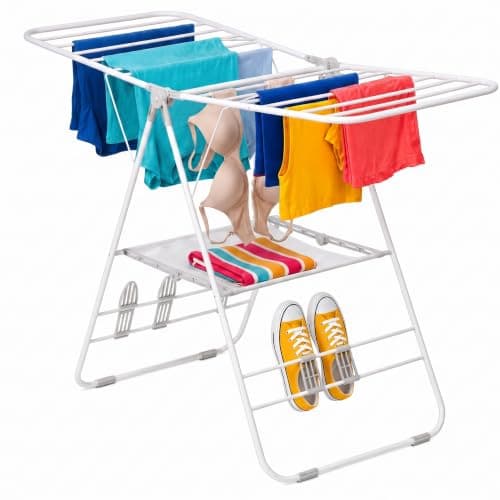
Pick 2 · A full washer load in one go
Honey-Can-Do Heavy-Duty Gullwing Clothes Drying Rack, 50 lb
46 linear feet and a 50 lb rating - the rack that takes an entire load without a second trip, if you can spare the floor.
What the manufacturer publishes
- Open
- 56.89"D x 23.82"W x 37.8"H
- Folded
- Folds flat (depth not published)
- Drying line
- 46 linear feet
- Load capacity
- 50 lb
- Material
- Metal
Figures from Manufacturer listing on Amazon, retrieved 2026-09-02.
Open, this is nine and a half square feet - about the size of a two-seat sofa laid on the floor. That is the price of doing a whole load at once, and in a studio it is a real price.
46 feet of line is enough for a standard washer load with the shirts spaced rather than crammed, which is the difference between four hours and nine.
The wings fold down when you only need the middle section, so it can run at half width on a normal day and full width on laundry day.
Good
- 46 linear feet - the most usable line per dollar here
- 50 lb rating handles wet towels and jeans
- Dedicated shoe bars, which most racks skip
- Wings fold independently for narrow days
Not so good
- Nearly 5 feet wide open
- 7.3 lb, so it is not the one you carry between rooms
Skip this if your apartment cannot give up a 5 foot span for four hours. Measure the actual gap before you buy this.
#ad · how this is funded · price as of October 16, 2026
Common questions
Why do air-dried clothes feel stiff?
Two reasons. Fibers dry without being agitated, so they set flat and interlocked rather than raised. And detergent or mineral residue left in the fabric hardens as the water evaporates.
How do you soften air-dried towels?
Use less detergent, add an extra rinse, and shake each towel hard before hanging and again when dry. Those three between them fix most cases without buying anything.
Does vinegar soften air-dried laundry?
Half a cup of white vinegar in the rinse helps dissolve detergent and mineral residue, which is one of the two causes of stiffness. It does not leave a smell once the laundry is dry.
Does fabric softener help with air drying?
Not really, and on towels it reduces absorbency. Air-dried stiffness is caused by a lack of agitation and by residue, and adding another product to rinse out addresses neither.
Sources
- Manufacturer listing on Amazon - retrieved 2026-09-02
- Manufacturer listing on Amazon - retrieved 2026-09-02
- ENERGY STAR - Clothes Dryers product criteria and energy use - retrieved 2026-09-02
Read next

Air drying vs tumble drying
The honest comparison: cost, time, fabric wear and room humidity, with the trade-offs named rather than one side declared best.
How to dry clothes faster indoors
Every lever on indoor drying speed, ranked by time saved and priced per load, from the free habits to the appliances.
How to load a drying rack so clothes dry faster
Spacing, orientation and loading order - the free technique that changes indoor drying time more than any upgrade.

How to air-dry clothes inside without the smell
Why indoor-dried laundry goes musty, the four things that prevent it, and how to rescue clothes that already smell.
The best fans for drying clothes
Three fans compared on airflow per watt and noise level, with running cost per load and where to place one.
How to air-dry clothes without wrinkles
Why air-dried laundry creases, and the six steps - all of them free - that get most of a load off the rack needing no iron.